Getting Started with Agentic AI in Business Workflows

Abdul Fahad Noori
March 17, 2026





ABSTRACT: As agentic AI moves into business workflows, success is shaped by how agents are introduced into existing processes. When agents operate inside onboarding, claims, service fulfillment, or compliance workflows, they inherit the same data ambiguity, ownership gaps, and process assumptions that shape human work—often surfacing these issues faster and at greater scale.
This guide focuses on getting started with agentic AI in business workflows, examining how teams select initial use cases, constrain scope, define data authority, and assign ownership before autonomy expands. Drawing on practitioner discussion and field experience, it follows the progression teams encounter as agents move from introduction into day-to-day operation, highlighting why early decisions around governance, measurement, and oversight shape trust and long-term viability.
Introduction
Agentic AI is showing up on enterprise roadmaps for a simple reason: it promises movement. Not another dashboard or interface layer, but systems that can carry work forward across the middle of real business processes.
That promise becomes concrete when agents are connected to operational workflows such as onboarding, claims, underwriting, service fulfillment, billing, or compliance. In these settings, agents operate inside live systems, with real data and shared responsibility. Their behavior reflects the conditions of the workflows they inhabit.
This reality shaped the discussion in a recent webinar with Wayne Eckerson, Carlos Bossy, and Michael Spiessbach. Rather than centering the conversation on specific tools or architectures, the discussion focused on what agents encounter once they are embedded in day-to-day operations. Agents reason using the data available to them, follow the structure of existing processes, and act within boundaries defined by governance and ownership.
As the discussion progressed, a consistent set of planning questions emerged:
- Which business processes are appropriate starting points for agentic work?
- How much autonomy should an agent have early on, and how does that evolve over time?
- What data must be clear, trusted, and authoritative for agents to reason effectively?
- Where does ownership sit when agents operate across functions and systems?
- How should teams monitor performance and adjust behavior as conditions change?
This guide follows the same progression explored in the session. It reflects hands-on experience introducing agentic systems into production environments where consistency, trust, and long-term operation matter. Each section addresses a decision point teams encounter as agents move from initial use to sustained participation in business workflows.
1. What an Agent Is
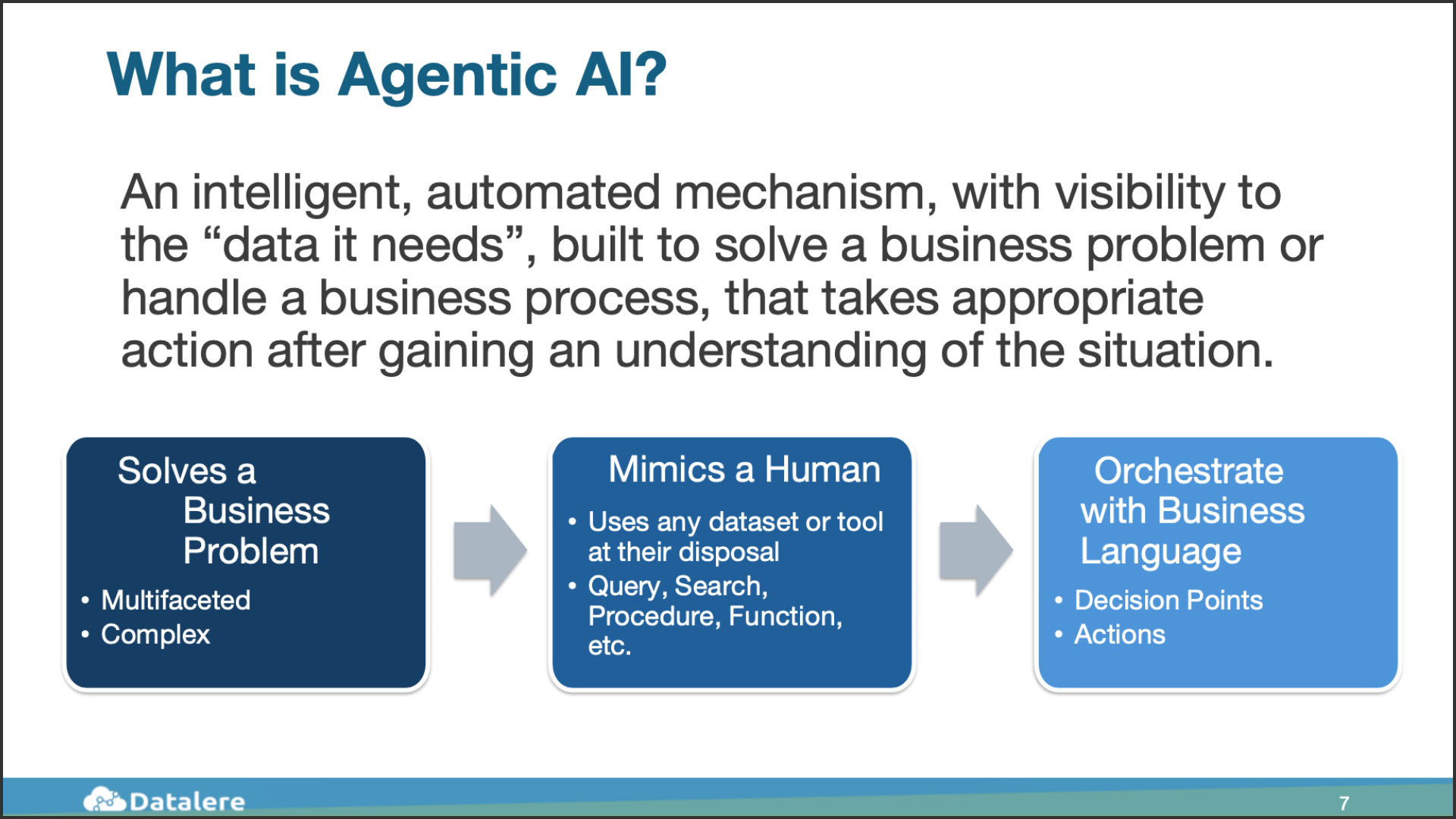
Agents are best understood as operational participants rather than a new category of interface or automation. An agent operates inside a business process. It observes context, gathers information from the systems it has access to, reasons about the situation, and moves work forward by taking or proposing actions. This cycle repeats continuously as conditions change.
Once connected to a workflow, an agent participates in that workflow. It encounters the same constraints, dependencies, and handoffs that shape human work. Its behavior reflects the environment in which it operates.
How agents reason in practice
Agents reason using the structures already present in an organization: data models, definitions, permissions, and process logic. They do not infer meaning where it has not been made explicit. When definitions vary, sources conflict, or context is fragmented, agents proceed using whatever signals are available.
Agents apply logic consistently. The quality of the outcome depends on the clarity of the environment.
A common example is customer data. If an organization cannot confidently identify which system holds the authoritative value for a basic customer attribute, an agent cannot resolve that ambiguity independently. It will select a value based on available context and continue operating. Over time, that choice becomes visible through repeated execution.
Speed makes assumptions operational
Agents surface these conditions quickly. They move faster than people and interact with more systems in less time. What might appear to be a manageable inconsistency in manual workflows becomes a recurring pattern when handled by an agent.
Implications for planning
Understanding what an agent is leads to two practical conclusions:
- Agents should be introduced into workflows that teams already understand, even if those workflows are inefficient or fragmented.
- The reliability of agent behavior closely tracks the clarity of data definitions, authority, and process structure already in place.
2. Selecting the Right Use Case
Start with work that already runs the business
Strong early agent use cases tend to sit inside existing operational workflows. These are processes that already run every day, where outcomes are understood and ownership already exists.
Such workflows often span multiple systems and roles. They involve routine decisions, coordination, and follow-through that depends on context being carried forward. Teams already know where effort is spent and where work slows down. Agents fit naturally here because the work itself is familiar and observable.
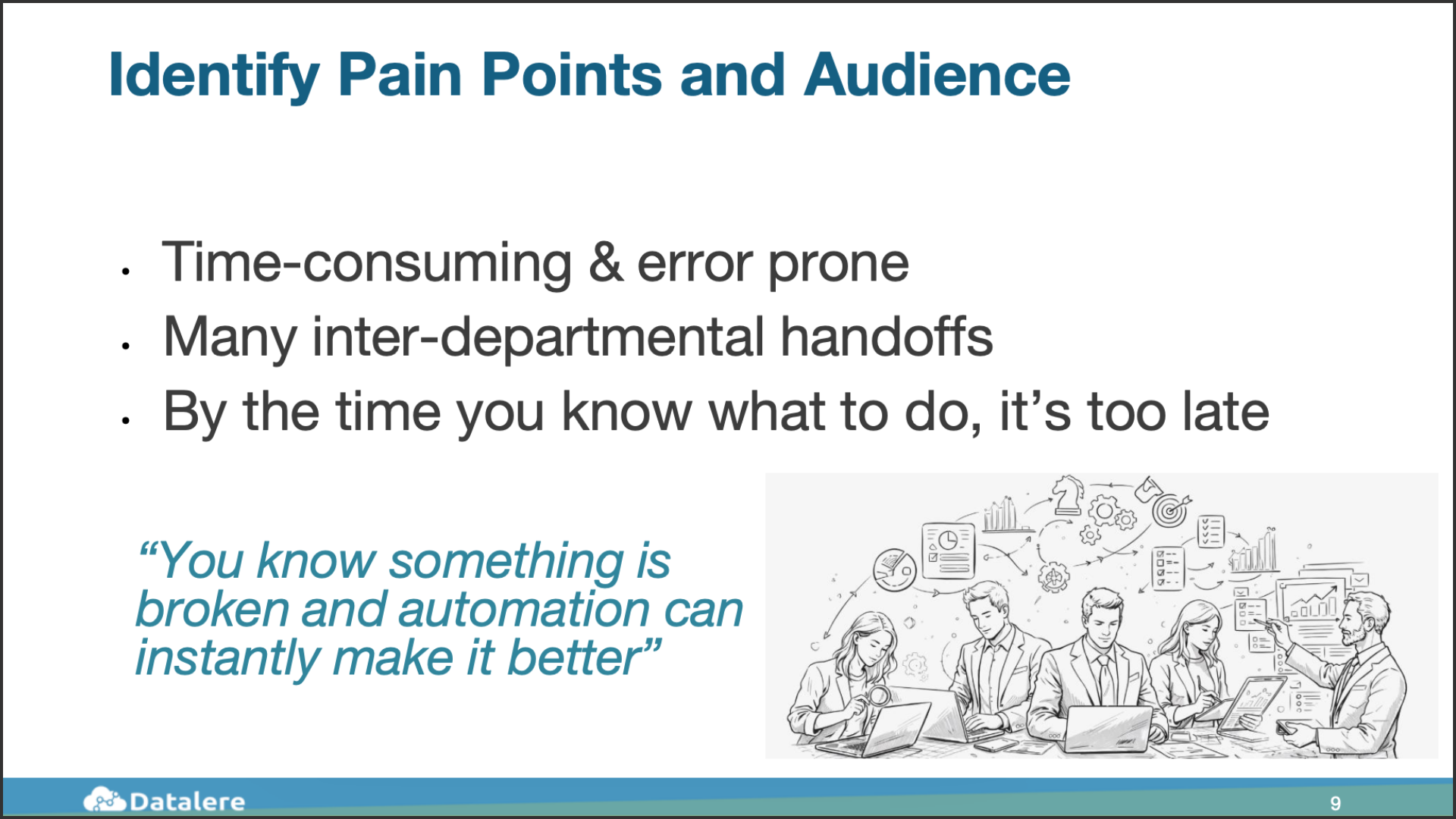
Friction is the signal
In practice, candidate use cases reveal themselves through friction in daily operations.
Common patterns include:
- Repeated reconciliation across systems
- Delays caused by scattered or missing context
- Routine tasks that compete with higher-value work
- Exceptions that interrupt otherwise predictable flows
These conditions point to places where continuity breaks down. Agents add value by maintaining context across steps and systems rather than optimizing individual tasks in isolation.
Scope enables learning
Early success depends less on ambition and more on restraint. Effective first agents operate within a deliberately constrained scope:
- A bounded workflow
- A repeatable decision pattern
- A defined set of systems
- A clearly identified owner
Constraining scope makes behavior easier to observe, review, and refine. It also limits unintended consequences while teams learn how agents behave in real operating conditions.
Frequency turns behavior into evidence
High-frequency workflows accelerate learning. Repeated execution makes patterns visible quickly: where agents encounter uncertainty, how often they escalate, and how outcomes change over time.
This repetition turns intuition into evidence. Teams can adjust based on observed behavior rather than assumption.
Ownership anchors responsibility
Clear ownership remains essential as agents take on responsibility. Someone must define boundaries, review outcomes, and decide when changes are required.
Early use cases succeed when ownership is explicit from the outset, even when workflows span multiple systems or functions.
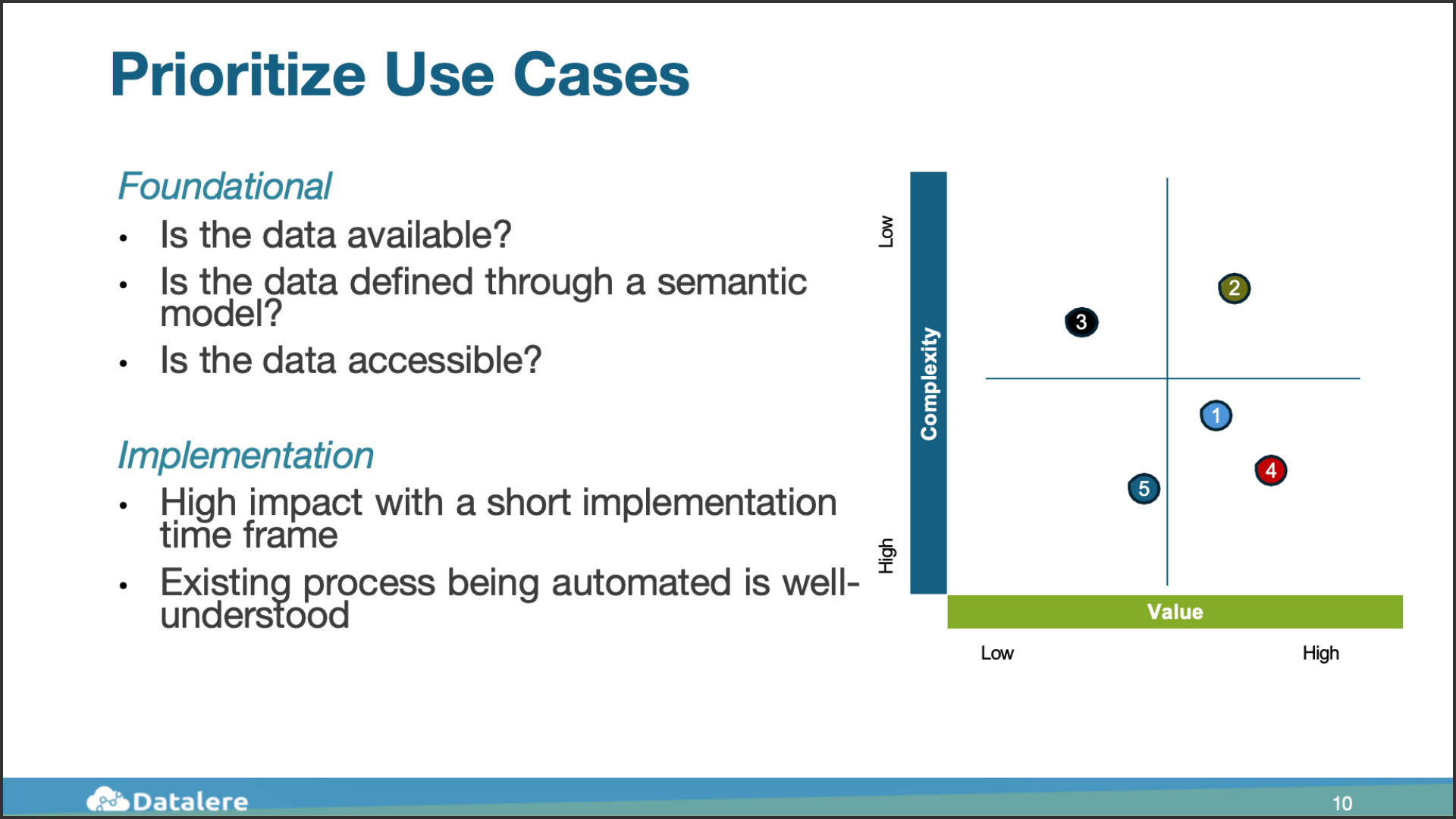
A practical filter for first use cases
Taken together, these characteristics provide a simple way to evaluate whether a workflow is a good starting point:
- The workflow is well understood by the people who run it
- Work requires coordination or reconciliation across steps or systems
- Outcomes are observable without heavy interpretation
- Ownership is clearly defined
- Scope can be constrained without undermining value
When teams get this first decision right, downstream choices about data readiness, autonomy, and oversight become easier to manage. When they do not, agents often surface misalignment later—through escalations, overrides, or stalled workflows. This is an area where we often work with teams early on. We help pressure-test initial use case selection based on how similar workflows behave once agents are introduced, clarifying scope, ownership, and boundaries before anything moves into production. If this is a decision you’re currently working through, you can schedule a no-pressure conversation with our team to compare notes.
3. Funding with ROI
Funding agents as operating decisions
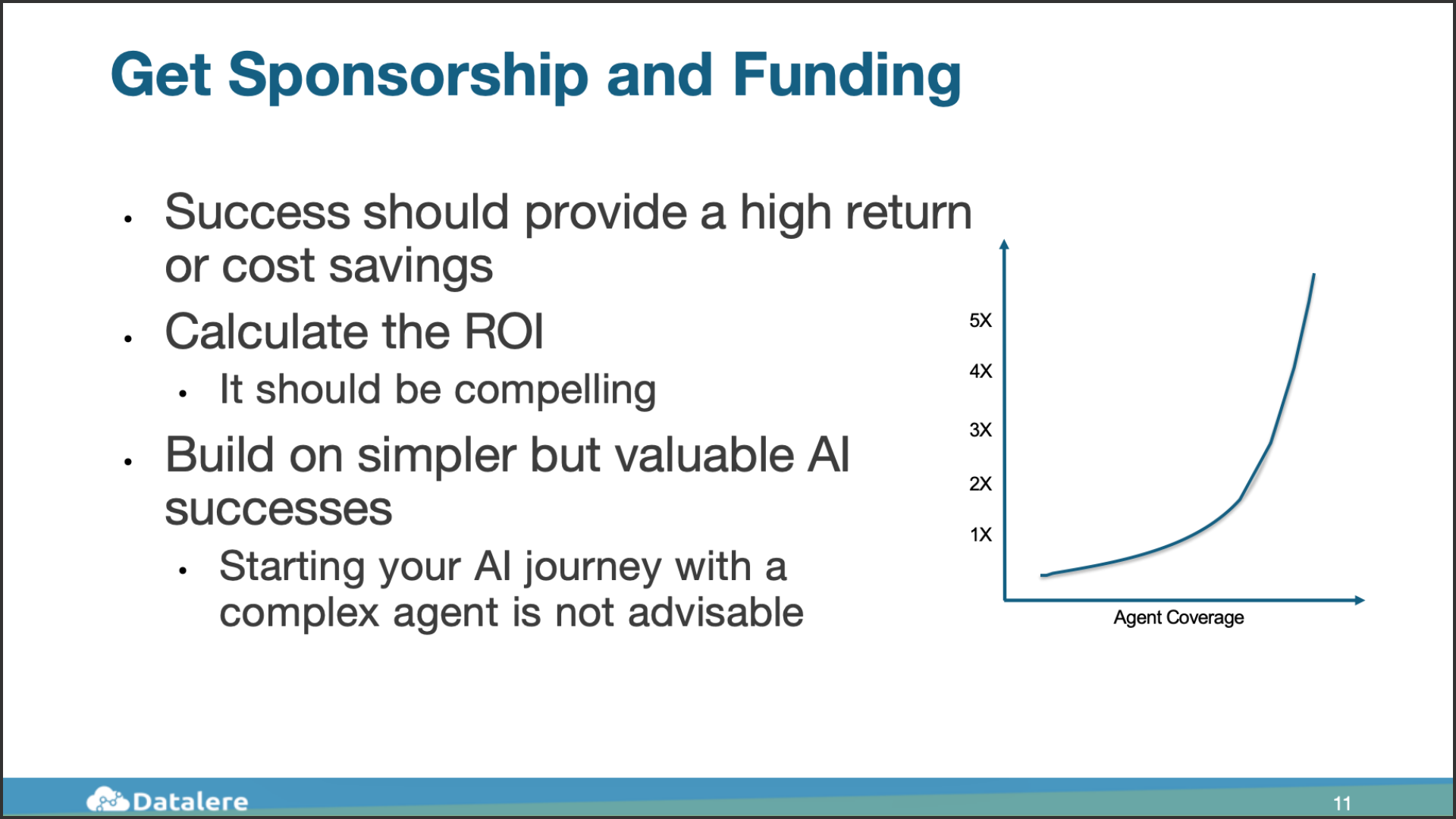
Funding agentic AI works best when treated as an operating decision rather than a one-time initiative. Agents are introduced to take responsibility for work that already exists inside a workflow. From the moment they begin operating, they inherit its constraints, dependencies, and expectations.
At this stage, ROI focuses on whether an agent improves how a specific workflow operates in practice.
Establishing a baseline that matters
Productive ROI discussions begin with a shared understanding of how the work currently runs: how long it takes, where coordination slows it down, how often exceptions arise, and how consistent outcomes are across cases.
The baseline does not need to capture every detail. It needs to be stable enough that change becomes visible once the agent is in place. Without that reference point, discussions about value tend to drift toward assumption rather than observation.
Why repetition reveals value
Once an agent is operating, value becomes visible through repetition. High-frequency workflows are particularly instructive because small changes compound quickly. Minor reductions in cycle time or improvements in consistency surface clearly as work runs continuously.
When behavior changes, it is easier to understand why. When outcomes improve, it is easier to attribute the improvement to agent involvement rather than surrounding noise.
ROI includes learning, not just efficiency
ROI at this stage also includes what teams learn once an agent is embedded in a real environment.
Agents surface conditions that often remain implicit in manual work: unclear data authority, fragile process assumptions, and gaps in oversight. These patterns appear quickly because agents execute the same logic repeatedly. What might have taken months to notice through human work becomes visible in days or weeks.
This learning reduces uncertainty, improves subsequent design decisions, and informs where additional responsibility can be introduced with confidence.
Funding as a progression
Effective funding models support progression rather than commitment. Teams fund a constrained first use case, observe how the agent behaves against agreed measures, and adjust scope or oversight based on evidence. Decisions to expand responsibility follow experience rather than projection.
Measurement as an input to governance
Signals such as cycle time changes, reductions in manual effort, consistency of outcomes, and frequency of escalation provide insight into both value and reliability. Over time, these signals feed governance decisions about where clarification, constraint, or redesign is needed.
4. Stakeholders, Accountability, and Trust
Agents change who is involved, not just what is automated
One of the clearest signals from the discussion was that agentic AI changes the stakeholder landscape. Once an agent operates inside a real workflow, its impact extends beyond the team that initiated it.
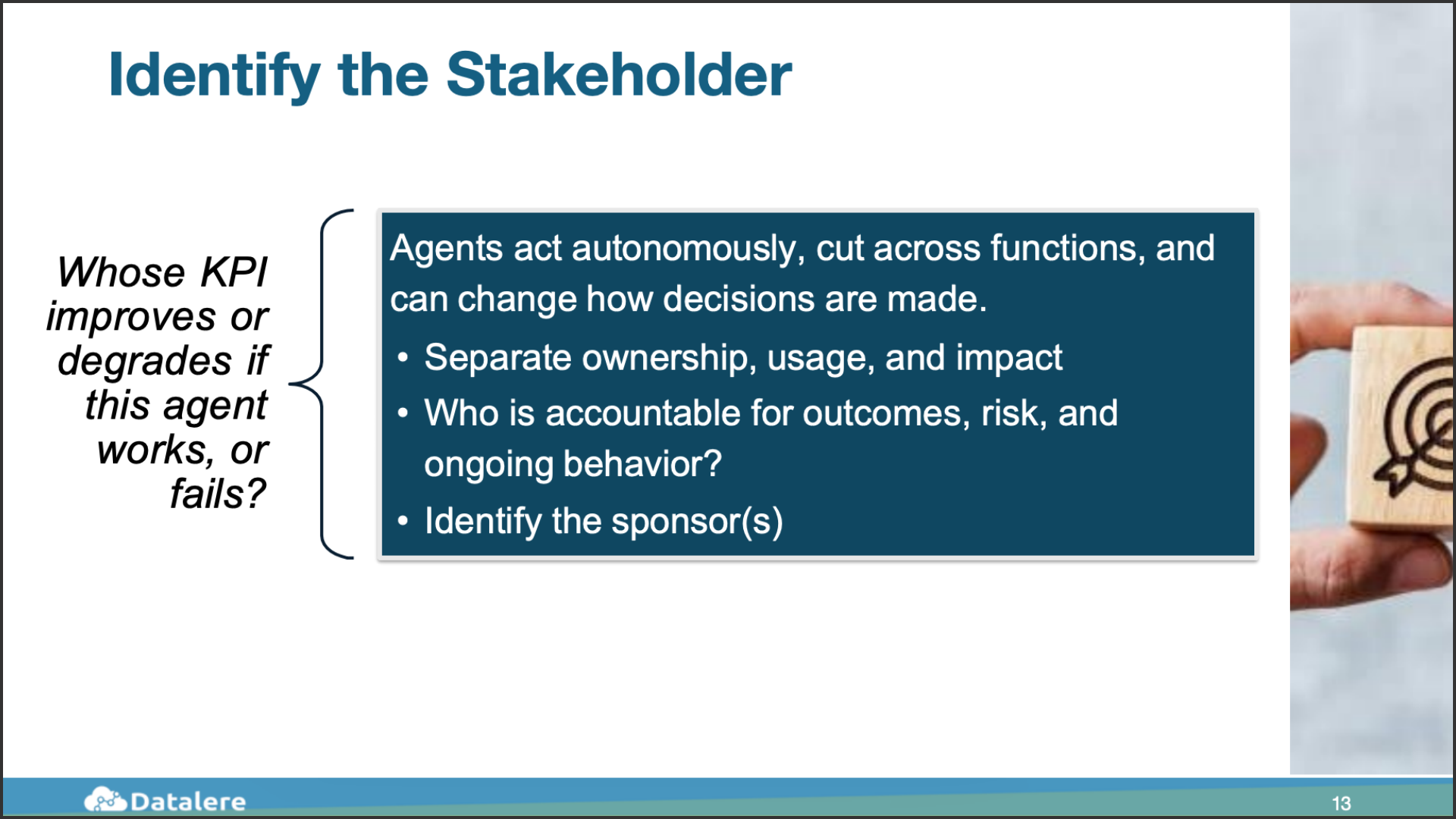
Agents affect outcomes that other teams are measured on. They influence cycle times, quality metrics, compliance outcomes, customer experience, and cost. As a result, questions about who is impacted and whose KPIs change surface quickly.
Teams that treat agent initiatives as isolated projects often discover this late. Teams that plan for it early tend to move faster, because expectations and incentives are aligned before autonomy increases.
Accountability does not disappear when agents act
Agents are designed to behave in ways that resemble human decision-making within a defined scope. That similarity raises a practical question: when an agent makes a mistake, who is responsible?
The discussion consistently returned to ownership. Agents do not own outcomes. People do.
In practice, ownership exists across several dimensions:
- Ownership of the workflow the agent participates in
- Ownership of the agent’s behavior and scope
- Ownership of validation, review, and escalation
When these roles are clear, mistakes are manageable. When they are not, trust erodes quickly, even if the agent performs well most of the time.
Sponsorship is earned through observable impact
Stakeholder buy-in does not come from novelty. It comes from observable improvement.
As agents begin operating, sponsors pay attention to outcomes that matter to them: faster resolution, reduced manual effort, more consistent decisions, and fewer handoffs. These signals translate agent behavior into business terms.
This is where ROI and sponsorship intersect. Clear evidence of impact creates executive support. That support, in turn, makes it easier to address cross-functional dependencies, data access questions, and governance decisions that would otherwise slow progress.
Agents require cross-functional thinking by design
Agents rarely fit cleanly inside a single function. To make effective decisions, they often need context that spans domains: operational data, customer data, policy rules, and historical outcomes.
This has two implications. First, agent initiatives cannot be framed purely as finance, marketing, or operations projects. They cut across functions by necessity. Second, data access decisions become central to agent design rather than an afterthought.
When agents are constrained to partial context, their decisions reflect that limitation. When they have access to broader, well-governed context, their behavior becomes more consistent and useful.
Security becomes a design question, not a gate
Broader access introduces real security considerations. Rather than treating these as late-stage blockers, the discussion reframed security as part of agent design.
One idea explored was the distinction between using sensitive data and exposing it. An agent may need sensitive signals to reason effectively without revealing that data in its outputs or actions. This enables designs where agents operate with richer context while maintaining strict controls over visibility.
Seen this way, security becomes part of the operating model: what data can be accessed, how it can influence decisions, and what is surfaced to humans. This framing helps reconcile autonomy with control.
Trust is built through structure, not assurances
Across the discussion, trust emerged as something built through structure rather than promise. Clear ownership, visible behavior, measurable outcomes, and thoughtful access design all contribute to confidence over time.
When teams know who is accountable, how decisions are made, and how issues will be handled, agents are easier to accept as part of day-to-day operations. Trust grows as agents behave predictably within well-defined boundaries.
5. Requirement
What needs to be in place before autonomy expands
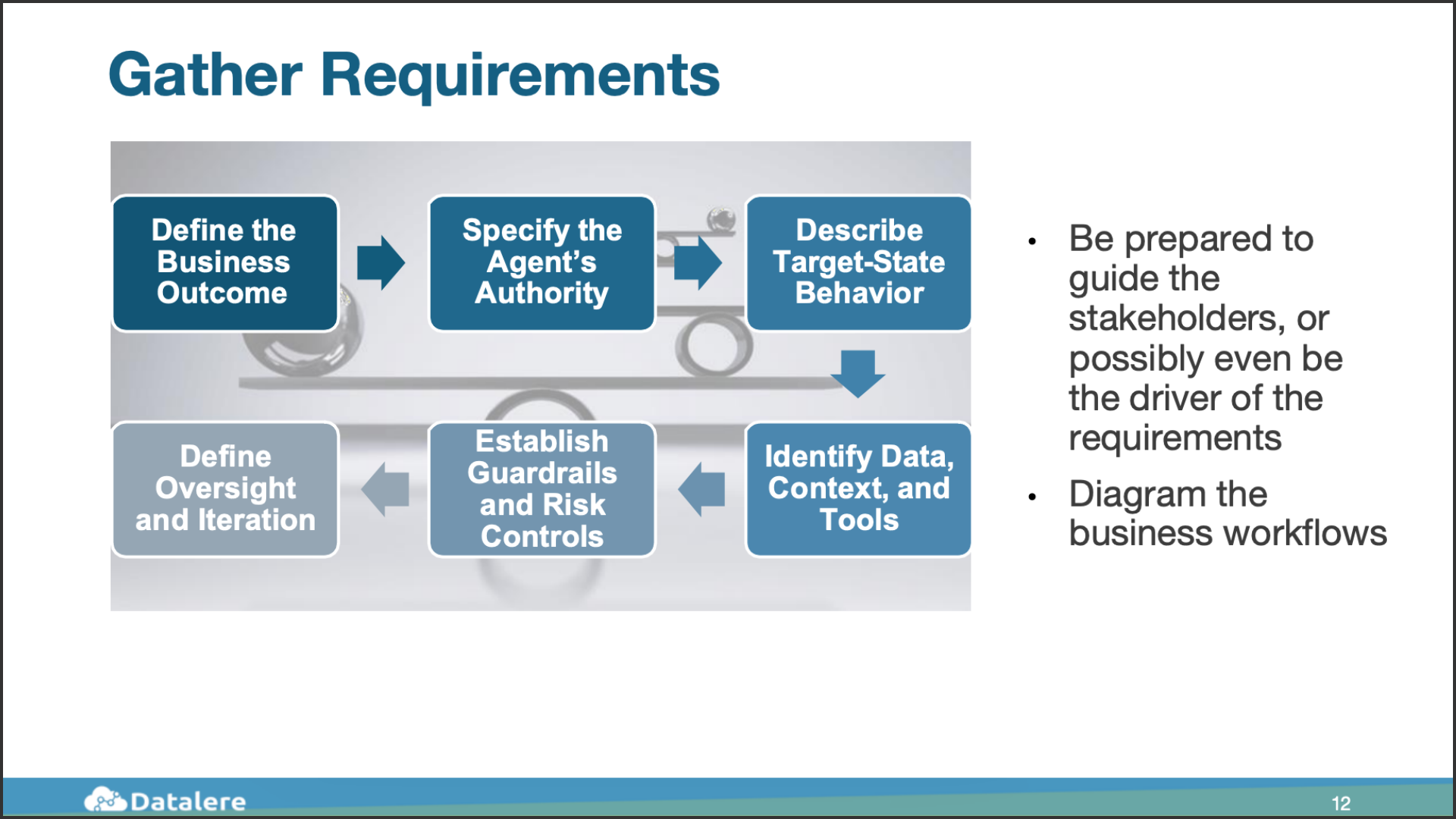
Once teams decide where to start and how to fund early agent work, attention shifts to requirements. Not requirements in the sense of feature lists, but the conditions an agent needs in order to behave consistently inside real workflows.
Agents are not deployed into a vacuum. They operate inside environments shaped by data definitions, access rules, process logic, and human oversight. The quality of those conditions determines how reliable an agent can be as responsibility increases.
Authority: what the agent is allowed to trust
One of the first requirements agents encounter is authority. Authority determines which data sources the agent treats as definitive when information conflicts or context is incomplete.
In practice, this often surfaces through basic questions. Which system holds the authoritative customer record? Which status should the agent rely on when systems disagree? What should the agent do when no clear source of truth exists?
These decisions cannot be deferred to the model. They must be made explicit. When authority is clear, agents behave predictably. When it is not, agents still act, but their behavior reflects whatever assumptions are embedded in the environment.
Behavior: how the agent is expected to operate
Agent behavior is defined by goals, constraints, and the range of actions an agent is permitted to take.
Early on, teams benefit from being explicit about:
- What outcomes the agent is responsible for
- Which decisions it can make independently
- When it should escalate to a human
- How it should behave when information is missing or ambiguous
These expectations do not need to cover every edge case. They need to be clear enough that agent behavior is understandable when reviewed after the fact.
Tools and actions: what the agent can actually do
Agents reason, but they also act. The actions available to an agent shape how useful it can be in a workflow.
Depending on the use case, this may include the ability to:
- Read and write data
- Trigger workflow steps
- Call functions or procedures
- Retrieve context from search or knowledge systems
- Generate outputs used by downstream systems or people
Making these capabilities explicit helps teams reason about risk, oversight, and scope. It also prevents agents from becoming passive observers when the intent is for them to move work forward.
Guardrails and oversight: how control is maintained
As agents begin operating inside workflows, guardrails become part of the operating model rather than an afterthought.
Guardrails define the boundaries within which an agent can act. Oversight defines how behavior is reviewed, corrected, and refined over time. Together, they allow teams to expand autonomy without losing control.
Effective oversight does not require constant human intervention. It requires visibility into behavior, clear escalation paths, and the ability to adjust constraints as conditions change.
Data readiness revisited
Many of these requirements converge on data readiness, but not in the abstract sense. What matters is whether data is usable in practice.
Usable data has clear definitions, stable semantics, and agreed authority. It is accessible to agents within appropriate controls. When these conditions are met, agents can reason in ways that align with how experienced team members would approach the same work.
When they are not, agents expose the gap quickly.
In practice, teams often discover that aligning these requirements is less about tooling and more about coordination—getting business owners, data leaders, and governance stakeholders to agree on authority, behavior, and oversight.
This is where we’re frequently asked to step in. We help teams facilitate these conversations, align expectations across roles, and resolve ambiguity early so agents can operate with confidence as autonomy expands.
If this kind of alignment work is on your roadmap, you may find it useful to speak with one of our senior consultants about our approach.
6. Using Business Processes to Surface Agent Requirements
One of the most practical recommendations in the session was also one of the most concrete: walk the business process.
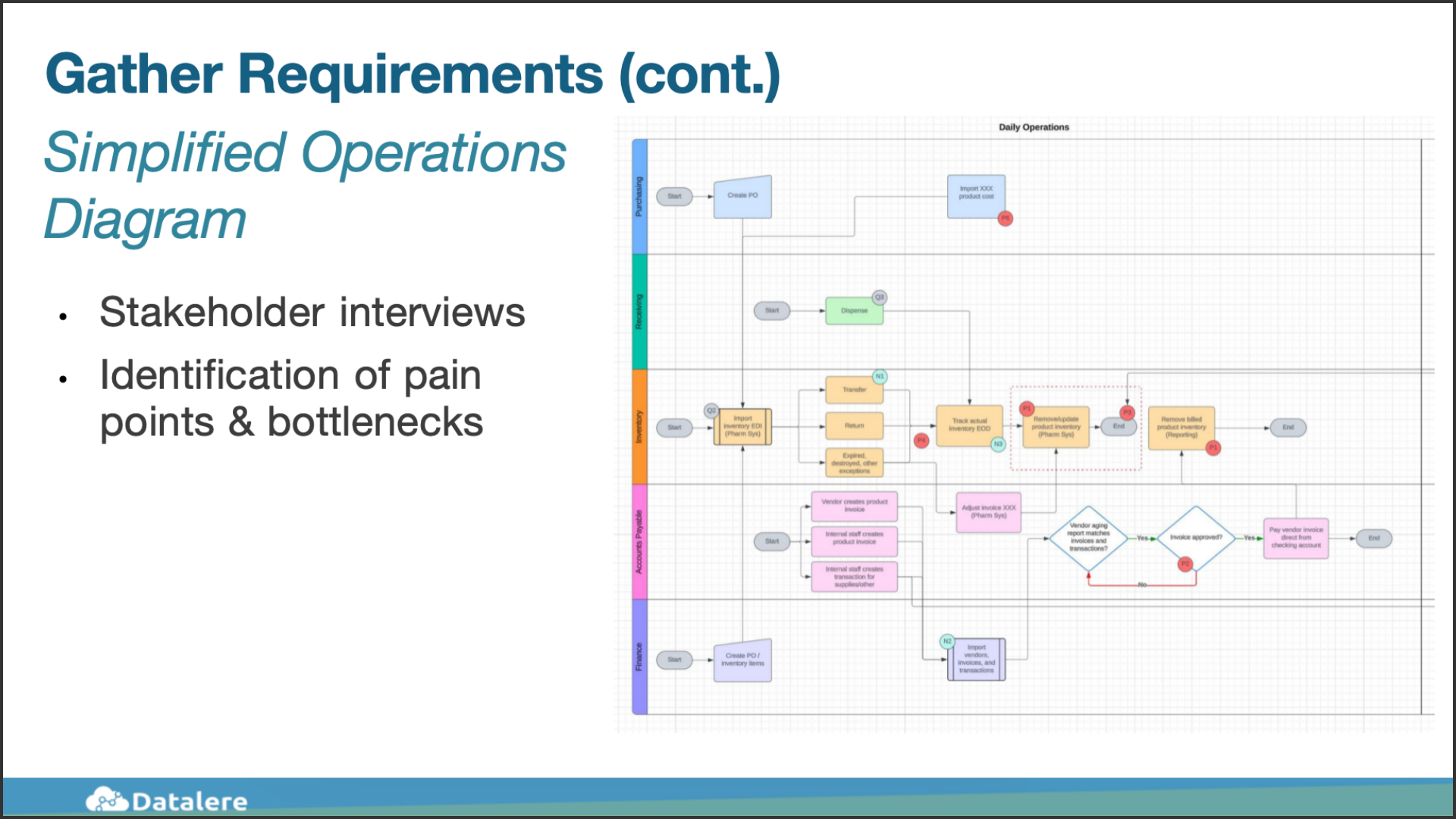
Not at a conceptual level, but step by step, the way work actually happens today. Carlos Bossy described this as diagramming the process in detail and then examining, at each step, how an agent would behave if it were performing the work alongside a human.
This framing matters because agents do not operate at the level of outcomes alone. They operate at the level of steps. Each decision, lookup, validation, and handoff becomes a point where the agent must reason using available context and take or propose an action.
Agents behave like people inside processes
When agents are embedded in workflows, they encounter the same conditions people do. They depend on upstream inputs, rely on data produced by other teams, and operate within informal assumptions about what is sufficient to proceed.
Mapping the process step by step makes these conditions visible. It highlights where judgment is applied, where context is carried forward implicitly, and where people compensate for missing or unclear information. These are the moments where agent behavior needs to be defined explicitly.
Carlos Bossy also emphasized that an agent may operate across multiple steps in a process, sometimes spanning departments. A single agent might retrieve information from one system, apply business logic owned by another team, and initiate an action that affects a third. Viewing agents as isolated functions breaks down once the process is examined end to end.
Process mapping clarifies responsibility and risk
As processes are mapped in detail, questions of responsibility naturally come into focus. Some steps carry more risk than others. An agent that proposes a recommendation operates under different expectations than one that completes a transaction.
One example discussed in the session was a workflow that culminates in paying a vendor. That endpoint requires a higher level of confidence than earlier steps. Mapping the path to that action helps teams understand where trust must be highest, where oversight is required, and where autonomy can be introduced incrementally.
In this sense, process mapping serves two purposes at once. It documents how work flows today, and it reveals where responsibility concentrates as work moves forward.
Process mapping as a shared capability
Wayne Eckerson noted that this type of process-level thinking is increasingly becoming part of how data teams operate. As agents move closer to business operations, understanding how work flows across systems and teams becomes a practical requirement.
The value of this work is not in producing polished diagrams. It lies in making dependencies explicit: where data originates, how decisions are sequenced, and which teams are involved at each step.
When processes are mapped collaboratively, they create a shared reference point across business, technical, and governance roles. Business teams clarify intent and expectations. Data teams identify what information and access are required. Security and compliance considerations surface as part of the design conversation rather than later as constraints.
Why this step precedes data evaluation
Process mapping sets the context for evaluating data sources. Once teams understand what decisions an agent must make at each step, they can assess whether the required data exists, whether it is authoritative, and whether it is usable in practice.
Without this process lens, data evaluation tends to remain disconnected from how work actually happens. With it, data readiness can be assessed directly in relation to the decisions and actions an agent is expected to perform.
This leads naturally to the next step: examining the data sources agents would rely on, how trustworthy they are, and where gaps must be addressed before responsibility expands.
7. Evaluating Data Sources for Agent Readiness
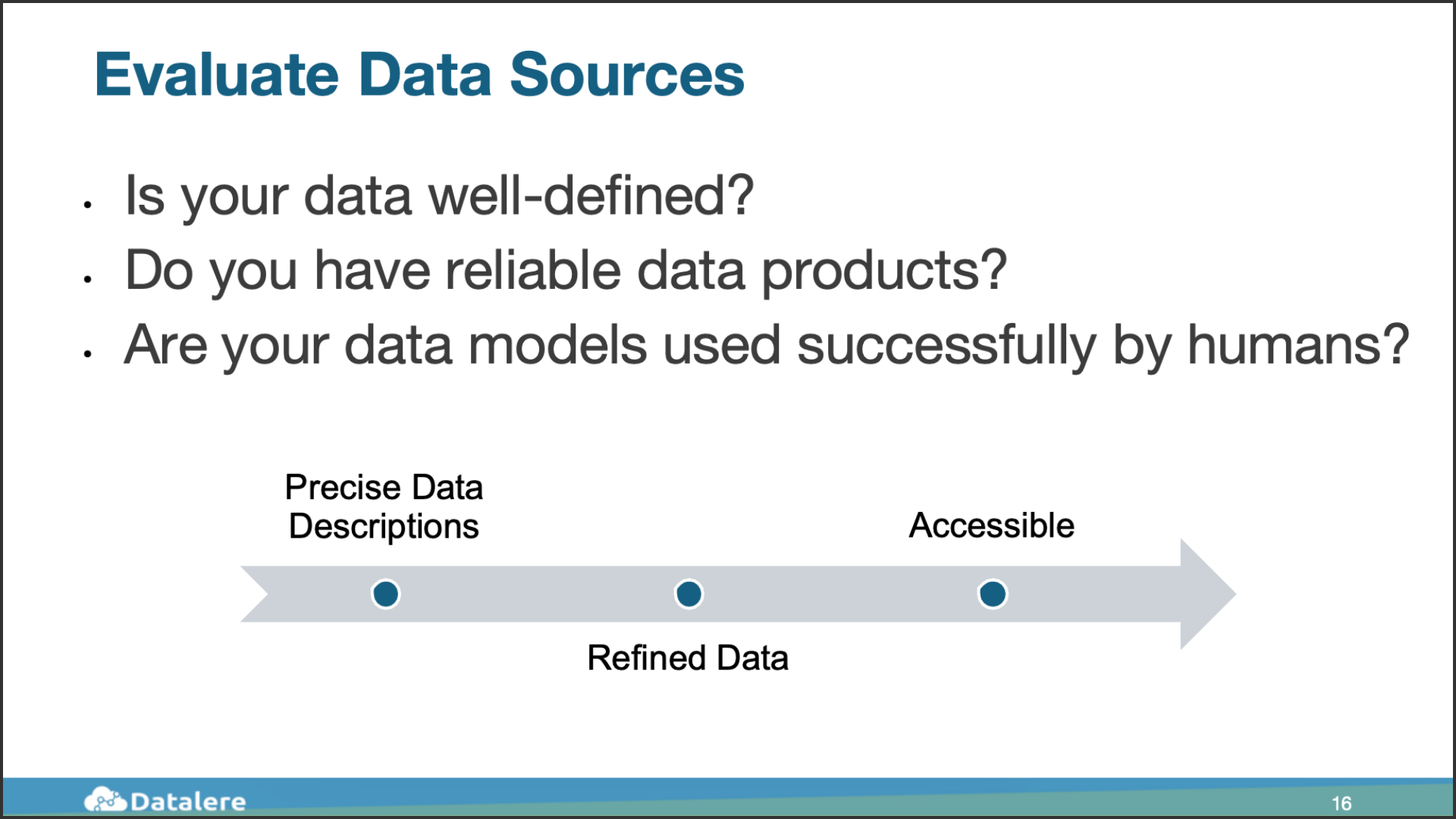
Once business processes are understood step by step, teams can examine the data an agent would rely on at each point in the workflow.
Agents operate using the same information structures that support human work. The quality, clarity, and accessibility of that data shape how agents reason and act once they are embedded in operational systems.
A practical readiness check
One way to assess readiness is to look at how reliably teams can access and use data today. When reports arrive late, definitions vary across teams, or reconciliation is manual, those conditions carry forward into agent behavior.
Agents apply logic to the context they are given. When that context is fragmented, decisions reflect the available signals. This makes data usability a central consideration in planning agent participation in workflows.
Usability here is practical rather than abstract. Teams can ask whether people can confidently retrieve information, whether definitions hold across uses, and whether outputs are trusted without repeated verification.
The birthday example
Carlos Bossy illustrated this with a simple example: customer birthdays.
In many organizations, a customer’s birthdate appears in multiple systems, recorded at different points in time. Marketing, billing, support, and CRM platforms may each hold a value, without a clear agreement on which one is authoritative.
An agent working in that environment encounters the same condition. When asked for a birthday, it selects a value based on available context and proceeds. Over time, that selection becomes part of the workflow’s behavior.
The example highlights how unresolved data authority shapes outcomes once agents are introduced.
Data usability and enterprise outcomes
During the discussion, an attendee referenced research indicating that many enterprise AI initiatives encounter difficulties because data is not ready for operational use. This observation aligned with experiences shared by the speakers.
Enterprise data environments are often complex. Definitions vary, metrics are interpreted differently across teams, and lineage may be difficult to trace. These characteristics influence how both people and agents work with data.
Agent readiness depends on whether data structures support consistent interpretation and use.
Evaluating data in process context
Effective data evaluation happens in relation to specific process steps. For each point where an agent must make a decision or take action, teams can examine:
- What data is require
- Where it originates
- Whether that source is authoritative
- How definitions are applied across systems
- What access controls are in place
Agents supporting operational workflows often need information that spans domains such as finance, operations, sales, marketing, or inventory. Evaluating data sources across these domains helps clarify whether agents can reason with sufficient context.
Architecture patterns that support clarity
The session also touched on architectural patterns that help make data more usable in practice.
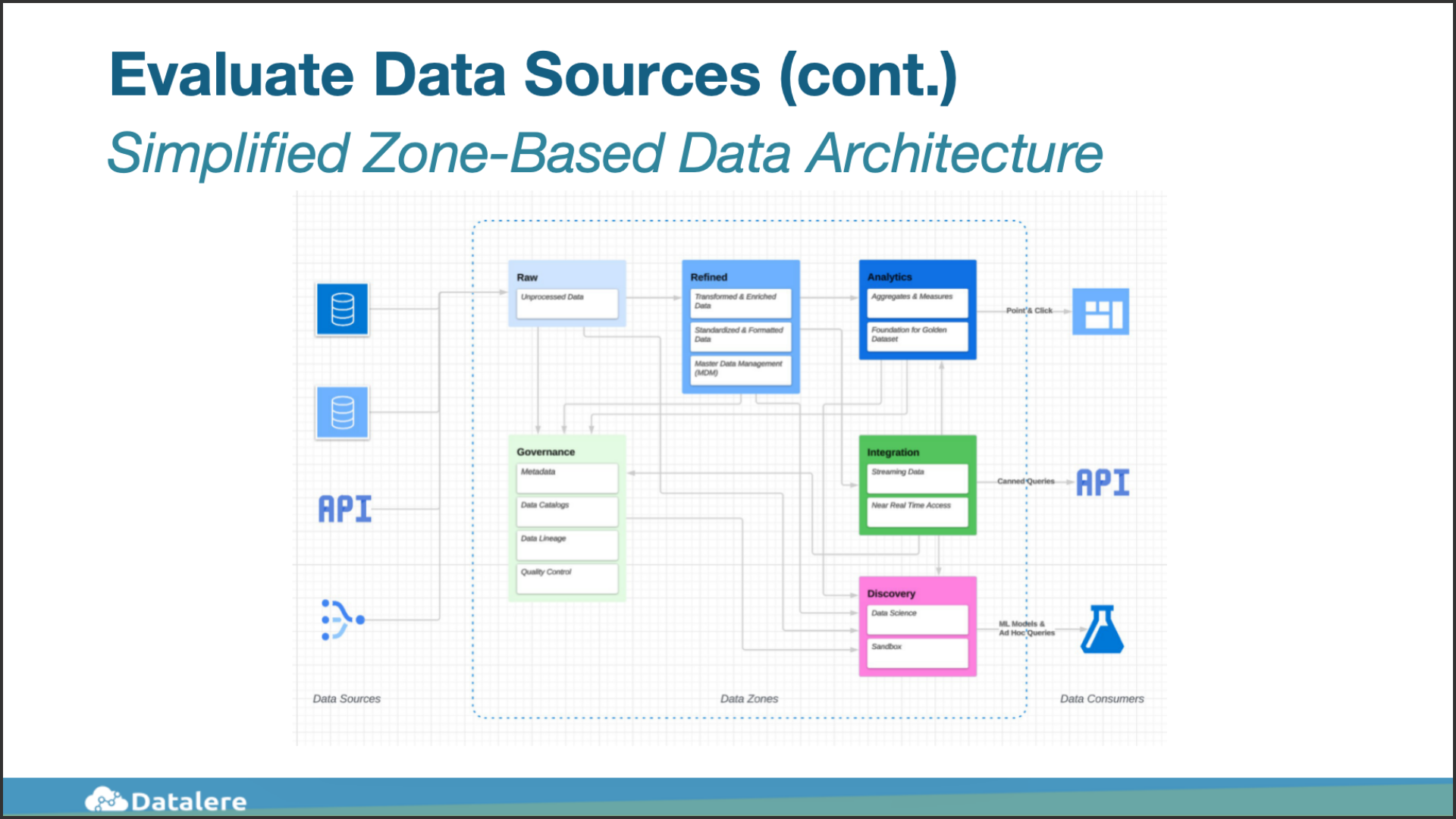
Zone-based architectures—such as raw, staged, and analytics layers, or bronze, silver, and gold zones—help distinguish between provisional data and data intended for decision-making. They provide clearer signals about where refinement occurs and where information can be relied on.
Well-modeled data further supports consistent interpretation. Carlos Bossy pointed to star schemas as an example of structures that make relationships and metrics explicit. Clear modeling reduces ambiguity for both people and agents.
Other approaches, including data vault patterns, were mentioned in the same spirit: emphasizing lineage, consistency, and clarity rather than prescribing a single design.
Readiness over time
Data readiness evolves as agents take on more responsibility. Early use cases may operate within limited scope, while later stages require higher confidence in authority, consistency, and accessibility.
Evaluating data sources becomes an ongoing activity informed by how agents interact with workflows and where clarification is needed. Observed behavior provides input into how foundations are refined as participation expands.
8. Measures of Success and Ongoing Operation
When agents begin participating in day-to-day workflows, changes in how work moves through the process become visible. Decisions progress differently. Human intervention increases or decreases at specific steps. These shifts appear through normal operation rather than special instrumentation.
Measurement served two purposes in the discussion. It helped workflow owners understand whether agents were improving the work they were introduced to support, and it informed decisions about how responsibility and autonomy could evolve over time.
Anchoring measurement to outcomes
Measurement begins with clarity about outcomes. Agents are introduced to influence how work progresses through a workflow: how long it takes, how much effort it requires, and how consistently decisions are handled.
Rather than focusing on model-level metrics, workflow owners compared how the process behaved before and after agent involvement. Changes in speed, cost, and reliability surfaced naturally as part of routine execution.
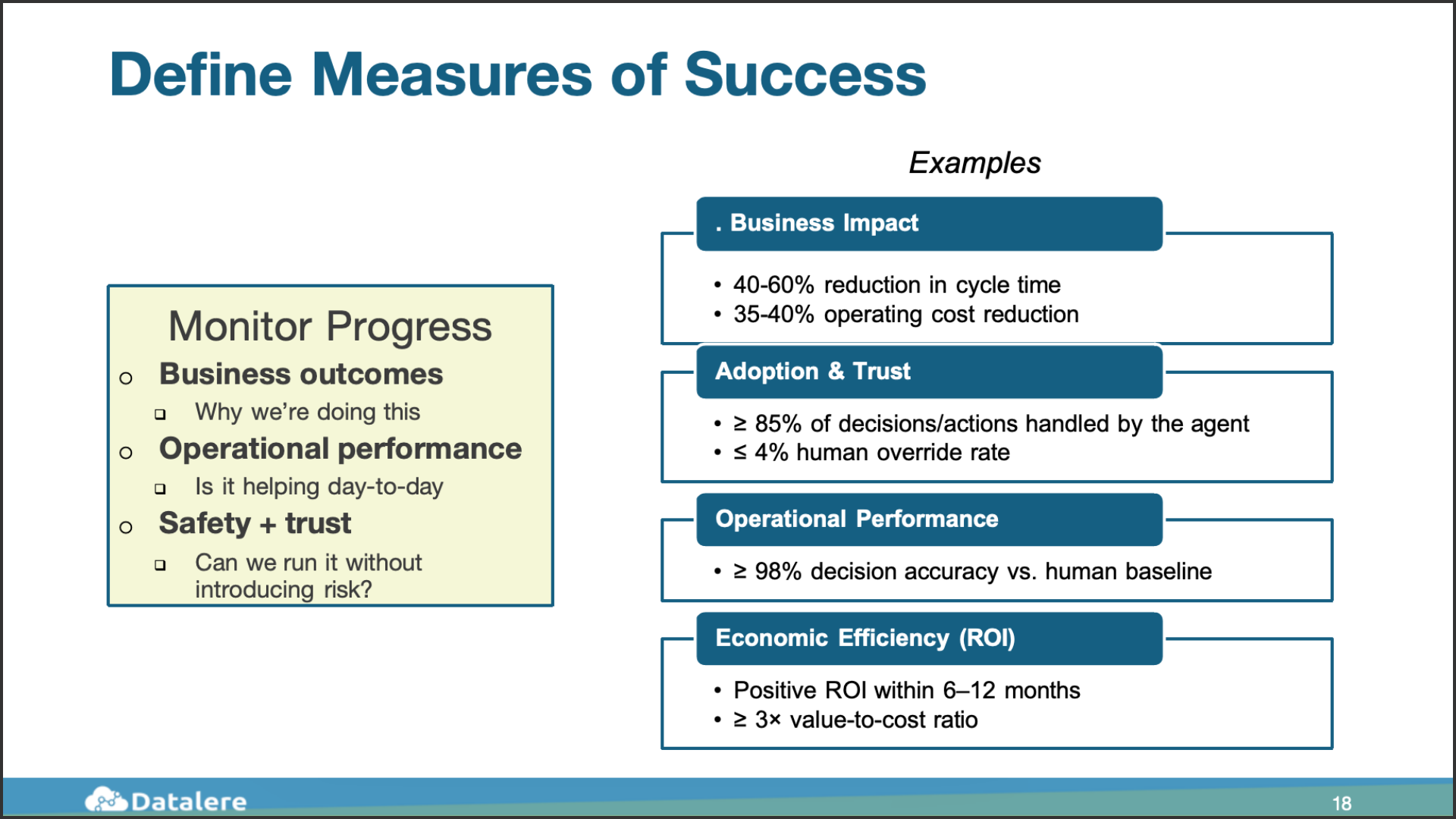
Carlos Bossy emphasized monitoring progress against clear outcomes and confirming that agent behavior remained within agreed guardrails. Measurement functioned as part of how confidence was maintained as agents took on responsibility.
Signals observed in practice
Across the discussion, several measures emerged as useful reference points. These were discussed relative to an agreed baseline for the workflow rather than as universal benchmarks.
● Cycle time
Workflow owners compared how long the process took before and after agent involvement. In examples discussed, cycle-time reductions in the range of 40–60% were observed when agents reduced handoffs or maintained continuity across steps.
● Operating cost
Changes in manual effort, rework, and intervention were tracked alongside cycle time. In operational settings where agents absorbed routine coordination, cost reductions on the order of 35–40% were cited relative to baseline operation.
● Decision share and override rate
Owners tracked the proportion of decisions handled by the agent and how often humans intervened. One example involved agents handling the majority of routine decisions (around 85%), with low single-digit override rates. Sustained override levels around 30% were treated as a signal that agent behavior, data authority, or available context required refinement.
● Operational accuracy
Accuracy was evaluated against the existing process baseline rather than idealized expectations. In more mature cases, accuracy levels approaching the high nineties were cited when data definitions and process structure were well established.
These measures were most informative when viewed together. Patterns across cycle time, cost, decision share, and overrides provided a clearer picture of reliability than any single metric alone.
Overrides as feedback
Override behavior carried particular meaning in the examples discussed. Frequent intervention often pointed to gaps in data authority, unclear expectations, or missing context at specific steps in the workflow.
Lower override rates indicated closer alignment between agent behavior and how the work was expected to be handled. Tracking this balance over time helped workflow owners adjust autonomy deliberately as confidence grew.
Before-and-after comparison
Michael Spiessbach highlighted the importance of capturing baseline measures before agents were introduced and comparing them to observed behavior afterward. This before-and-after view provided concrete evidence of impact and informed decisions about what to adjust next.
Measurement supported progression rather than final judgment. It provided input into whether scope should expand, guardrails should tighten, or underlying data foundations needed refinement.
Operating over time
As agents remained active, measurement became part of the operating model. Workflow owners observed behavior, reviewed outcomes, and adjusted constraints as conditions changed. Drift, changes in data, or evolving business rules all influenced how agents performed.
Sustained success came from treating measurement as an input to ongoing operation rather than a one-time evaluation.
Over time, teams often reach a point where the question is no longer whether agents are working, but how to interpret what they are showing. Changes in override rates, escalation patterns, or cycle time may reflect healthy learning—or signal deeper structural issues in data or process design.
Datalere helps interpret operational signals in context, distinguishing normal adaptation from conditions that require intervention as agent participation expands.
We’re happy to talk through what the signals may indicate in your environment. Schedule a conversation today.
Closing Takeaways: Operating Agents Over Time
As the discussion concluded, the focus returned to a small set of fundamentals that persist regardless of use case or architecture.
Agents need to be tied to clear business outcomes and to owners who are accountable for those outcomes. When responsibility is explicit, decisions about scope, autonomy, and escalation remain grounded in how the business actually operates.
Trust, control, and governance are not secondary considerations. They shape how agents are allowed to participate in workflows and how confidence is maintained as responsibility expands. Questions about who can access which data, and under what conditions, remain central as organizations scale agent use across functions and systems.
Ongoing oversight matters because agents operate in environments that change. Data definitions evolve. Processes shift. Policies are updated. Without periodic review, agent behavior drifts as the conditions it depends on change beneath it. Monitoring and adjustment are part of sustaining reliable operation, not signs of failure.
Taken together, these considerations point to a consistent theme: introducing agentic AI is less about deployment and more about operation. When agents are grounded in clear outcomes, supported by accountable ownership, and governed with intent, they can participate reliably in day-to-day work as conditions evolve.
If you’re exploring how agentic AI fits into your operations—or working through questions of scope, ownership, data authority, or ongoing governance—we’re happy to talk.
We work with organizations to design, launch, and operate agentic systems inside real business workflows, with a focus on clarity, accountability, and long-term reliability.
Schedule a conversation with our team to discuss your situation or speak with one of our senior consultants.
Abdul Fahad Noori
Fahad enjoys overseeing all marketing functions ranging from strategy to execution. His areas of expertise include social media, email marketing, online events, blogs, and graphic design. With more than...
Talk to Us