BI in Hospitality Is Going Against the Grain with Simpler Reporting

Abdul Fahad Noori
May 06, 2026





ABSTRACT: This article explores how BI in hospitality is moving in a different direction, shifting from interactive dashboards to simpler, purpose-built reporting that fits into the flow of daily operations.
In hospitality, effective use of data often means spending less time in dashboards and more time with customers.
For decision-makers across a property, the day is already structured around morning reviews, guest issues, staff coordination, and on-the-floor decisions. Data only becomes useful if it fits into that rhythm, not if it requires stepping away from it.
As a result, there is limited time to engage with tools that require extended interaction or exploration.
Hospitality data doesn’t sit in a single, unified system. Properties are often owned by different groups, such as private equity firms or family offices, while being managed across multiple brands and platforms. Reporting, as a result, is typically required across a mix of systems, stakeholders, and definitions.
This combination of fragmented data and limited time shapes how information needs to be delivered.
At Sage Hospitality, this has led to a different approach, one that prioritizes how quickly information can be understood within the flow of operations. The approach was discussed in a recent webinar featuring speakers Matt Schwartz from Sage Hospitality, Carlos Bossy from Datalere, and moderator Wayne Eckerson from Datalere, where they shared how reporting and analytics are being adapted to better fit the realities of hotel operations.
Why Hoteliers Are Moving Away from Dashboards
Instead of expanding the use of interactive dashboards, the team moved toward static, purpose-built PDF reports that highlight only the information needed to run the business. The focus is on clarity and consistency, presenting a defined set of metrics that can be reviewed quickly and used without additional interpretation.
This approach is reflected in a few design choices.
Reports are structured around a minimum set of relevant information, rather than offering multiple views or drill paths.
The format remains consistent across properties, making it easier for teams to interpret performance without having to reorient each time.
Reports are distributed via email, fitting into the existing rhythm of the day, whether that is a morning review, a daily stand-up, or a quick check between operational tasks. No additional step is required to access the information, and no change in behavior is required.
Keeping data within this existing flow has helped improve adoption to almost to 100%, as Matt Schwartz noted during the discussion.
How AI Is Being Integrated into the BI Layer
With a consistent reporting structure in place, the next step is to make the insights more actionable. To support this, Sage Hospitality introduced an LLM layer on top of its BI layer.
Each report is accompanied by a short narrative summary, placed at the beginning of the first page. This summary highlights key movements in performance and provides context around what is happening and where attention may be required. In many cases, the initial questions are already addressed before the numbers are reviewed.
As this layer becomes part of the reporting workflow, it also begins to change how analysis is approached.
Operational reports often include numerous measures across properties and timeframes. These metrics are reviewed regularly, but identifying what actually requires attention can still take time. Over time, everything becomes visible, but little stands out.
In this context, the role of the LLM layer is to narrow the focus. Instead of working through each metric, teams are guided toward the few signals that stand out, whether it is a shift in occupancy, a variance in rate, or a change in restaurant performance.
What makes this possible is the underlying data foundation.
For the narrative and prioritization to be useful, the system needs a consistent way to define and relate metrics across properties. This includes standardizing how performance is measured, modeling relationships between key data points, and ensuring that the same definitions are applied consistently.
The semantic layer plays a key role here. It provides a shared structure that allows both reports and AI-generated outputs to align with the business's understanding of performance, rather than relying on raw or inconsistent data.
This becomes particularly important as the system begins to surface insights. The outputs are not just generated from data, but from how that data is defined and connected. Without that structure, the same inputs could lead to different interpretations across teams.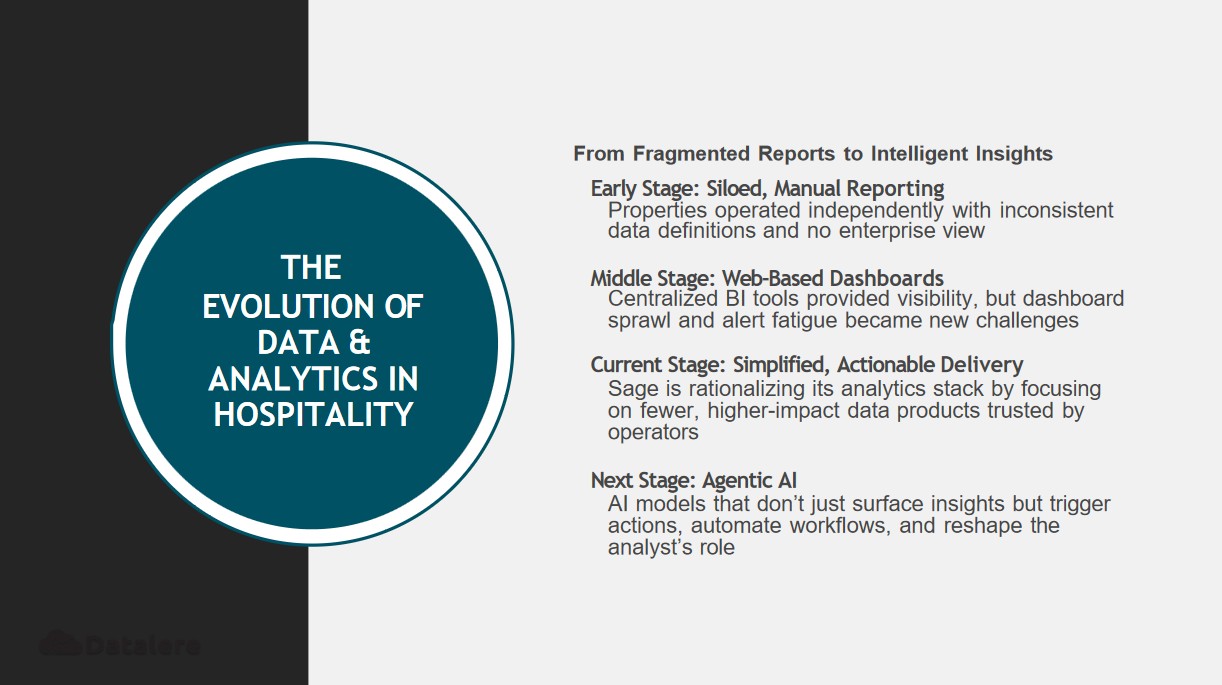
Using External Signals to Improve Hotel Forecasting
Hotel performance is influenced by a wide range of external factors, many of which sit outside traditional reporting systems. Events, travel patterns, weather, and local demand shifts all play a role in shaping occupancy, pricing, and overall performance.
In practice, incorporating these signals has often relied on manual inputs and experience. Teams draw on their understanding of the market to interpret how these factors might influence demand across properties.
By integrating both internal and external inputs, these relationships can be considered more systematically. Performance can be interpreted within a broader context, rather than in isolation.
This becomes particularly important in forecasting. Anticipating demand requires understanding how multiple variables interact over time, not just relying on historical trends.
This is where the focus on proprietary models becomes more relevant. Rather than relying solely on generic forecasting approaches, the discussion pointed toward models that reflect the specific operating patterns, property mix, and market dynamics of the business. These models bring together historical performance and external signals in a way that aligns more closely with how the business operates.
What This Means for Hotel Operations
Across all these changes, the objective remains consistent.
Data is meant to support decisions without adding friction to the day. In a hotel environment, where time is limited and attention is focused on guests and operations, the way information is delivered becomes as important as the information itself.
Simplifying reporting, structuring data more clearly, and adding an interpretive layer allows teams to stay aligned without stepping away from what they are responsible for managing.
This approach has been shaped through collaboration. Datalere has worked closely with Sage Hospitality to build a strong data foundation that supports consistent reporting across properties.
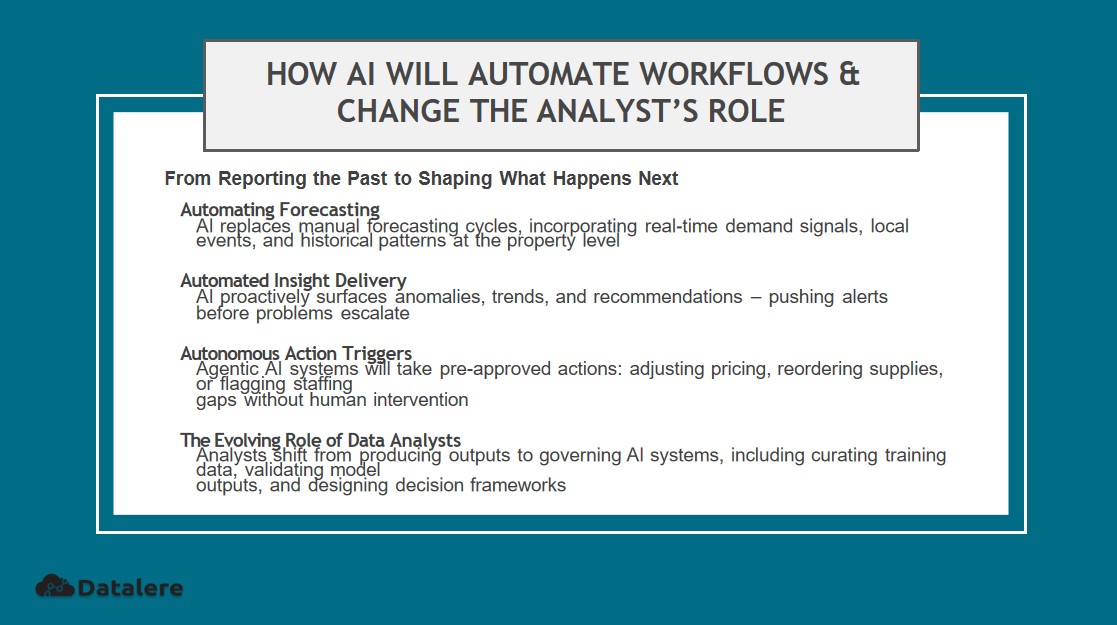
With that foundation in place, the focus is now shifting toward an agentic layer that introduces AI analysts and begins to automate the repeatable parts of the analytical workflow, while keeping the human element central to decision-making.
This piece was written by the author with support from AI tools for drafting and refinement. The perspectives and interpretations are based on the webinar discussion and the author’s own editorial judgment.
Abdul Fahad Noori
Fahad enjoys overseeing all marketing functions ranging from strategy to execution. His areas of expertise include social media, email marketing, online events, blogs, and graphic design. With more than...
Talk to Us